奇皇后
Twin AI satellites fast-track China's global space partnerships_我的网站

A | The trailer of Happy Patel: Khatarnak Jasoos is finally out. It promises a madcap ride powered by humour, chaos and heart. This wild ride is directed by Emmy-nominated comedian Vir Das in his directorial debut and produced by Aamir Khan Productions. The film is set for a theatrical release on January 16, 2026.
The trailer was unveiled on the official YouTube channel of Aamir Khan Talkies as well as on social media platforms. The film also marks Vir Das’ second collaboration with the banner after Delhi Belly.
Vir Das stars as Happy Patel, a self-proclaimed international spy with unmistakable Indian roots and a knack for landing in trouble. Described as “a chef, an agent (kind of), a hero (probably),” Happy finds himself facing violence, the Goa Police, and an unexpected romantic turn. Mithila Palkar stars opposite him, while Vir’s straight-haired, Bob Dylan-esque look adds to the film’s offbeat nature.
View this post on Instagram
A post shared by Aamir Khan Productions (@aamirkhanproductions)
The ensemble cast includes Mona Singh, Sharib Hashmi, and Srushti Tawade. Mona Singh takes on a brand new avatar as she plays a strikingly raw, gangster-like avatar.
The end of the trailer teases a character played by Aamir Khan. He is seemingly in a spirited and completely different role.
As a treat to fans, the film also marks the much-awaited theatrical comeback of Jaane Tu… Ya Jaane Na actor Imran Khan. He is returning to the screen after over a decade. His last release was Katti Batti opposite Kangana Ranaut in 2015.
Co-directed by Kavi Shastri and co-written by Amogh Ranadive, the film leans into bilingual humour and playful satire, cheekily flipping the popular meme by suggesting that “India is for beginners.” The trailer hints at a perfectly imperfect spy story that doesn’t take itself too seriously.Also Read: Aamir Khan makes a sharp airport appearance in an understated look。
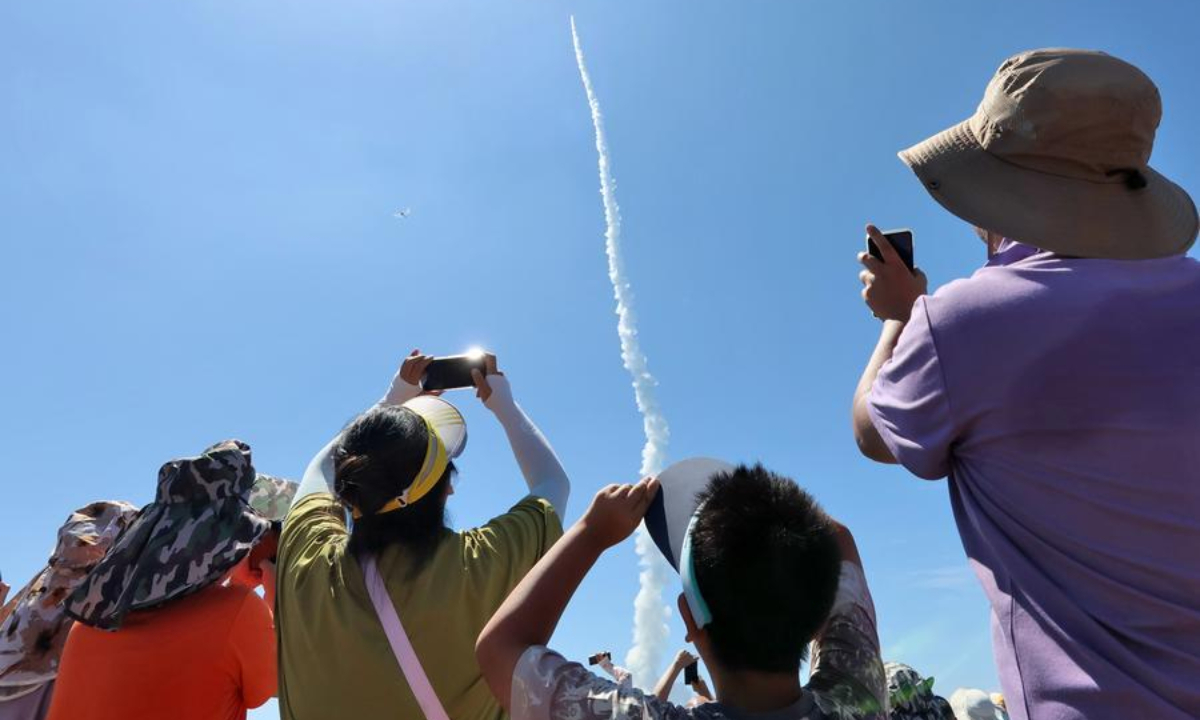
People watch a Smart Dragon-3 carrier rocket, carrying Oriental Smart Eye hyperspectral satellites 01 and 02, blasting off from the sea near the city of Haiyang, east China's Shandong Province, Aug. 5, 2026. (Photo by Tang Ke/Xinhua)
A burst of flame lit the morning sky over waters off Haiyang in east China's Shandong Province on Wednesday as a Smart Dragon-3 (SD-3) carrier rocket lifted off, drawing cheers from viewing sites along the coast.
Among the spectators were international students studying aerospace subjects in China. Aithana Perez, a Venezuelan aeronautical engineer studying space project management at Hangzhou Innovation Institute of Beihang University, said she and her classmates were excited because their studies involved spacecraft launch, design and operation.
For Marwane Oufrid, a 23-year-old Moroccan student in the same institute specializing in microsatellite technology, it was the first time he had watched a rocket launch in person.
The rocket blasted off at 10:38 a.m. (Beijing Time), delivering the Oriental Smart Eye hyperspectral satellites 01 and 02 into planned orbit.
In their respective cooperation projects with Indonesia and Uzbekistan, Satellite 01 is also known as Lampung-1 and Satellite 02 as Samarkand-2028.
Once in orbit, the satellites turned their attention back toward Earth. Lampung-1 is expected to monitor crop growth and disaster risks in Indonesia, while Samarkand-2028 is designed to support cotton cultivation and other land-monitoring applications in Uzbekistan.
Ordinary optical cameras mainly record the shape and color of objects. Hyperspectral imagers record a detailed spectrum for each image pixel, creating "spectral fingerprints" that can help determine the condition and composition of vegetation, water, soil and minerals.
These spectral "eyes" are paired with onboard AI computing modules capable of delivering up to 400 trillion operations per second. Instead of sending every raw image to the ground, the satellites can identify features, detect anomalies and extract useful information in orbit, potentially shortening delivery time from days to minutes.
Song Bingchen, co-founder of the Star.ai Spatio-temporal Intelligence Technology Co., Ltd., whose subsidiary STAR.VISION developed the satellites, compared the system to moving an AI inference platform from the ground into space.
"It changes the traditional model from transmitting images to transmitting results," Song said.
"Our satellite constellations are open to the world," Song noted, adding that the company welcomes international partners to jointly invest in, build and use the satellite networks.
In Indonesia, Lampung-1's planned applications are centered in Lampung Province on the island of Sumatra. Agriculture, forestry and fisheries accounted for 28.38 percent of the provincial economy in the third quarter of 2025. The satellite will also support marine resource management, environmental monitoring and disaster response.
Rahmat Mirzani Djausal, governor of Indonesia's Lampung Province, described the successful launch as a "historic moment" for the province.
"Cooperation with China on this satellite project is of historic and strategic significance," he said. "It marks the beginning of Lampung's transformation into a technologically advanced province."
The governor commended China's openness in sharing space technology and its commitment to long-term cooperation.
"China understands that any problems we face on one side of the world will ultimately impact the other side. Therefore, it is essential to empower regions that are left behind to make the world ultimately a better place," he said.
This cooperation also extends to people. Lampung is preparing to send over 100 young professionals to China for training in remote sensing and satellite communications, with the goal of building local capacity in satellite operation, data processing and spatial analysis.
In Uzbekistan, the applications center on cotton, grain and vegetation monitoring. Samarkand-2028 is designed to follow cotton cultivation from sowing to harvesting, while Uzbekcosmos has said hyperspectral data will also be used to produce national cotton and wheat maps.
Mukhiddin Ibragimov, deputy director of the Uzbekcosmos Agency, described the project as one of the largest international space projects in Uzbekistan's history and a milestone in its national space program.
He called the launch "a great occasion," saying it was the first time Uzbekistan had participated in an international space mission of such scale.
Ibragimov said Uzbekistan sent a technical team to China early in the project and formed a working group with Chinese specialists to develop an AI model for onboard data analysis. This model focuses on crop classification, including cotton verification, grain identification and vegetation monitoring.
The resulting data will support agriculture, water resource management, environmental protection and emergency monitoring, among other applications, he revealed.
Ibragimov said no single country can handle all space-related tasks alone.
"We believe that partnership brings value. We see that China is doing the same thing," he said, adding that Uzbekistan is exploring further satellite cooperation with China.
The projects offer a commercial example of the approach set out in China's 2021 space white paper, which called for international cooperation based on equality, mutual benefit, peaceful utilization and inclusive development.
Back in Haiyang, Oufrid said projects of this kind could give more countries an opportunity to participate in the space sector. He expressed the hope to see such cooperation happen more often and "maybe someday with Morocco as well."
。
Current article:http://jrje14s.zongchaeiwengshuabaisisuofu.sbs/u176ung/20260826/9374.html
Published on:00:19:12